Free tool — no account needed
Chain of custody form template
Fill in what you know and download a printable PDF, or take the blank form and complete it by hand. Every copy includes a 8-row custody transfer log. Nothing you type is stored or sent anywhere but back to you.
Want the empty form to print and fill in by hand? Take it now — you don't have to fill anything in below.
What a printed form can't do
A PDF is only as good as the paper trail around it. Anyone holding the file can change a date, a name, or an item number and reprint it, and nobody receiving it later has any way to tell. That is not a flaw in this template — it is true of every custody form that exists only as a document.
A CustodyTrack record is tamper-evident instead: each entry is hash-linked to the one before it, so altering an earlier entry breaks the chain visibly. Every record gets a verification code that a recipient — opposing counsel, a lab, a court — can check themselves, without an account and without asking you for anything.
5 free Authenticated Chain of Custody Forms every month — no card required.
Who this form is for
It is a general evidence custody form, written for the people who have to account for an item's handling afterwards:
- Private investigators and forensic examiners documenting an acquisition — a device, a drive image, a downloaded account export — where you are often the only witness to your own collection. The acquisition-hash field is there for this.
- Attorneys and paralegals logging an exhibit from the moment it arrives, so its origin is on the record before anyone is asked to authenticate it.
- Officers, property clerks and evidence technicians who need a blank form now and whose agency system is not in front of them.
- Corporate security and incident-response teams recording an internal collection that may later have to be explained to someone outside the company.
- Students and instructors in criminal justice and forensics courses who need a realistic blank form without an account or an email address.
And who it is not for
“Chain of custody form” is used by several unrelated fields, and this one will not suit all of them. If you need a drug-testing custody and control form, an environmental or water-sampling form, or a clinical laboratory sample form, the testing laboratory issues its own — it is usually part of the service, it carries their identifiers, and a generic template will not be accepted in its place. Ask the lab. This form is for evidence custody in an investigative or legal context.
A filled-in example
Every field below is invented, and the scenario is generic — a laptop collected from a client office by an examiner. It is here because “what does a completed one look like” is the question people actually have, and a blank template does not answer it. The third column is why each entry is written the way it is.
| Field | Example entry | Why it is written that way |
|---|---|---|
| Case / matter number | 2026-CF-0417 | Whatever your matter is actually called. It only has to be the identifier the rest of your file already uses. |
| Agency / organization | Redacted Forensics LLC | The organization accountable for the item, not the individual — the individual goes in 'Collected by'. |
| Evidence item number | 0417-002 | Unique within the matter. Sequential per item is enough; the point is that nothing else in the file shares it. |
| Description of item | Dell Latitude 5420 laptop, silver, asset tag RF-1188 | Enough detail to tell this item from a similar one on the same shelf. A make and model alone is not. |
| Evidence type | Digital — computer | Drives how it is handled and stored, and tells a reader whether a hash should be present. |
| Serial / identifying number | SN 7HQ2XM3 | The manufacturer's identifier, transcribed from the device rather than from paperwork about it. |
| Date & time collected | 2026-08-14, 09:42 | The time of the physical taking, not the time you filled the form in. If those differ, note the gap. |
| Location collected | 2nd-floor server room, 118 Whitfield St | Specific enough to return to. 'Client office' is not a location. |
| Collected by | A. Okonkwo | The person who physically took custody, and who can later say they did. |
| Title / rank / badge | Digital Forensic Examiner | Establishes the basis for what follows. It is also what a reader uses to weigh the entry. |
| Authority for collection | Written client consent dated 2026-08-13 | Consent, warrant, subpoena, or engagement letter. The single most commonly left blank, and the first thing challenged. |
| Acquisition hash (digital evidence) | SHA-256 4f2a…c19b (full digest on the acquisition log) | For digital items, computed at acquisition. Recording it here is what lets anyone later show the image has not changed. |
| Storage location | Evidence locker B, shelf 3 | Where it went after collection. A gap between collection and storage is a gap someone will ask about. |
| Condition & packaging notes | Powered off. Tamper-evident bag TE-40219. Minor casing scuff, lid. | Damage noted on arrival cannot later be attributed to you. Record the seal number here. |
And the transfer log beneath it
Three entries from the same example. The log is the part that gets read closely, because it is where a gap shows.
| Date & time | Released by | Received by | Purpose |
|---|---|---|---|
| 2026-08-14, 11:05 | A. Okonkwo | M. Delacroix | Intake to evidence locker |
| 2026-08-18, 14:20 | M. Delacroix | A. Okonkwo | Forensic imaging |
| 2026-08-18, 17:50 | A. Okonkwo | M. Delacroix | Return to locker after imaging |
The three gaps that get noticed
- A blank authority field. The most commonly skipped entry on the form and the first one questioned. Consent, warrant, subpoena or engagement letter — name which, and date it.
- Time between collection and the first log row. In the example above the item is collected at 09:42 and logged into storage at 11:05. That 83 minutes is accounted for by the journey; if it were three days, it would need a line explaining why.
- A return that was never written down. Rows two and three are the same item going out for imaging and coming back. People routinely log the release and forget the return, which reads afterwards as an item that never came back.
What's on the form
14 fields across four sections, followed by a transfer log with 8 blank rows.
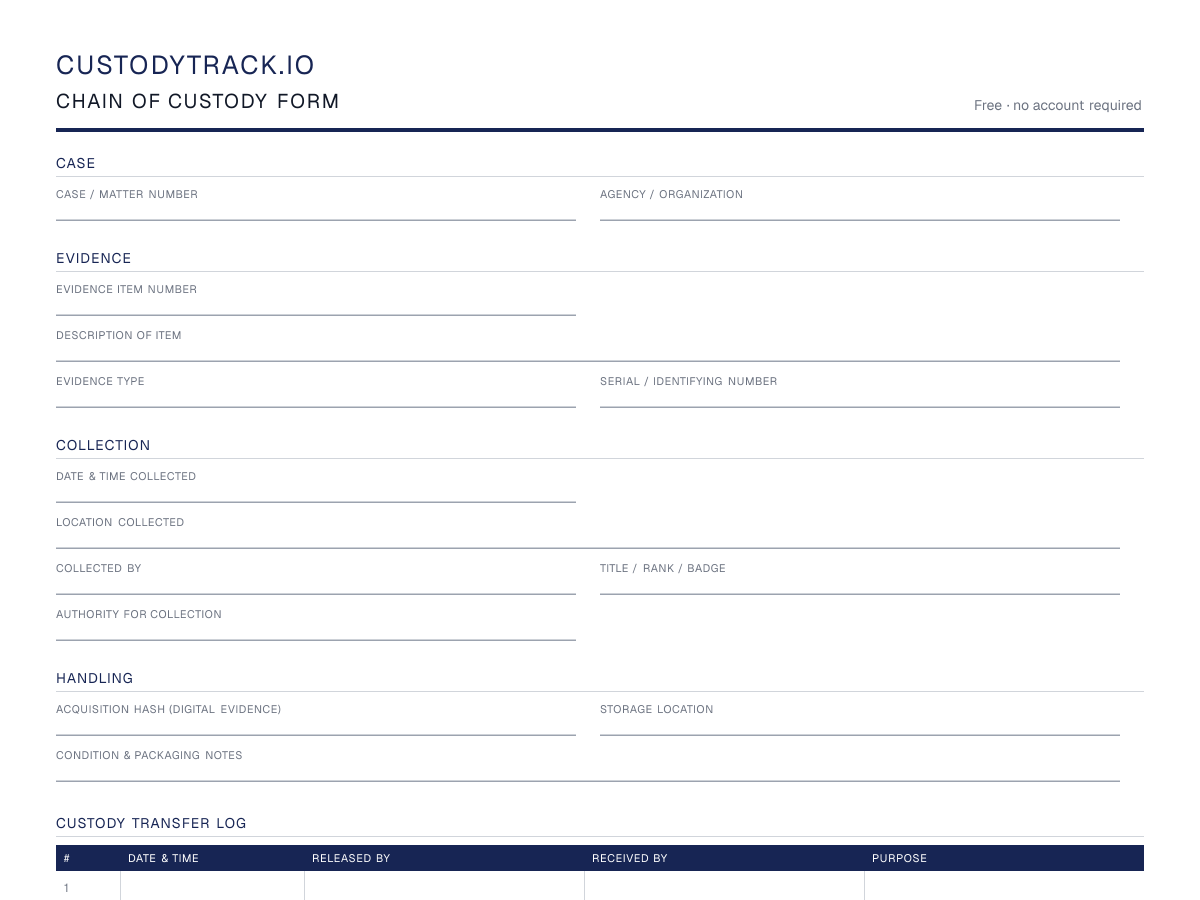
The blank form. Anything you fill in above replaces the ruled line.
- Case / matter number
- Agency / organization
- Evidence item number
- Description of item
- Evidence type
- Serial / identifying number
- Date & time collected
- Location collected
- Collected by
- Title / rank / badge
- Authority for collection
- Acquisition hash (digital evidence)
- Storage location
- Condition & packaging notes
Common questions
- Is this chain of custody form really free?
- Yes. The form generator is free, needs no account, and asks for no email address. You can download the blank form or a filled-in copy as many times as you like.
- What should a chain of custody form include?
- At minimum: a case or matter number, a unique item number, a description of the item, who collected it, and the date, time, and place of collection. It also needs a transfer log — a row for every time the item changes hands, showing who released it, who received it, when, and why. Unbroken sequence in that log is what the document is for.
- Where can I get a blank chain of custody form?
- Here, at no cost and with no account. Use the builder above and leave every field empty to download a blank printable PDF, or fill in what you already know first. There is no email wall and no watermark, and you can download it as many times as you need.
- How do I make my own chain of custody form?
- Start from a form that already has the fields a reviewer will look for rather than building one in a word processor. This generator produces a case or matter number, a unique item number, item description, collection details, an optional acquisition hash for digital evidence, and a transfer log — and a form you designed yourself is a form you may later have to explain, which is work you do not need.
- Can I fill the form in by hand after printing it?
- Yes. Any field you leave blank prints as a ruled line to write on, and the transfer log always prints with blank rows regardless of what you fill in.
- Can someone else confirm this PDF has not been altered?
- No. This generator stores nothing, so there is no record for anyone to check the document against, and the PDF carries no verification code. Its reliability rests on the paper trail and the signatures on it. A tamper-evident record that a recipient can independently verify is what a CustodyTrack account adds.
- Does this work for digital evidence as well as physical items?
- Yes. The form has a field for an acquisition hash so you can record the digest of a forensic image alongside the item details, and the description and location fields take a device path as readily as a street address.
Terms of use
The layout, instructions, and explanatory text of this form template are © Lexeprint Inc. You may use, complete, copy, print, and share it for any purpose, including commercial and official use. We ask that you keep the CustodyTrack.io credit on the form. You may not sell the blank template as your own product.
This is general information about evidence-handling practice, not legal advice, and it does not create an attorney–client relationship. Whether any record is admissible is determined by a court under the applicable rules of evidence. Consult qualified counsel about your own matter.
Provided "as is", without warranties of any kind. Lexeprint Inc. is not responsible for how a completed form is used, stored, or relied upon.
© 2026 Lexeprint Inc. All rights reserved.